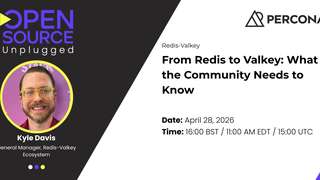
Redis has been a key technology for many developers, companies, and open-source communities for years. With the emergence of Valkey, many people are now asking what this change means, what stays familiar, and what new opportunities are opening for the community.
PMM 3 introduces new observability capabilities with Real-Time Query Analytics and High Availability. In this session, Tibor Korocz will explore how these features help teams troubleshoot faster and build a more reliable monitoring setup.
Percona is proud to sponsor PGConf.de 2026 in Essen — one of Europe’s leading events for the PostgreSQL community. This conference brings together engineers, contributors, and practitioners who are shaping the future of PostgreSQL in production environments around the world.
Character collations - the rules for comparing and sorting character strings - are not universal, even languages which use the same characters may sort them differently. These rules may also not be stable, and the libraries implementing them may have errors, requiring fixes and updates. When character string data is indexed or partitioned under one set of rules, then queried under another, it may create some problems.
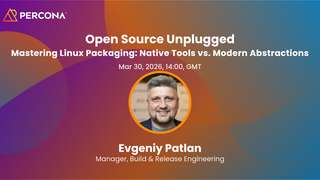
Building and distributing software for diverse Linux environments, like database servers and distributed systems, presents unique challenges in dependency management and lifecycle orchestration. In this session, Evgeniy Patlan will perform a deep dive into the packaging landscape, comparing the “gold standard” of native RPM and DEB tools against modern abstractions like CPack and nFPM.
Percona is proud to be a Silver Sponsor of Kubecon Europe 2026, one of the most important gatherings for the cloud native and open source ecosystem. The event will take place from March 23-26, 2026, at the RAI Amsterdam in the Netherlands.
Percona is taking part in the DB Mastery: In-Memory Databases summit on March 20, 2026. This virtual event focuses on how teams design and operate high-performance in-memory systems, covering low-latency data models, caching architectures, and scaling fast read/write workloads.
Setting up data-at-rest encryption correctly requires more than just flipping a switch. In this session, Konstantin Trushin will explain how Percona Server for MongoDB implements this critical security layer, covering the two-level key architecture and integration with industry-standard Key Management Systems (KMS) such as KMIP-compatible servers and HashiCorp Vault (along with its open source alternative, OpenBao).
Percona is proud to sponsor PGConf India 2026 as a Gold Sponsor, taking place from March 11th to March 13th, 2026, at the Sheraton Grand Hotel at Brigade Gateway in Bengaluru, India.
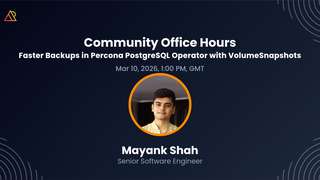
Discover how Percona’s latest PostgreSQL Operator feature transforms database backups with Kubernetes VolumeSnapshots. Learn the setup, benefits such as near-instant snapshots and improved disaster recovery, key limitations, and practical deployment steps for production workloads.
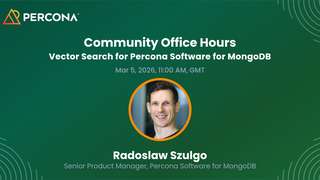
Discover how Percona is bringing Vector Search and Full-Text Search capabilities to the open source MongoDB ecosystem. In this session, we will walk through the strategic roadmap for integrating mongot, the engine powering these features into the Percona stack, offering community users a way to break free from Atlas-only limitations.
Percona is proud to sponsor SCaLE 23X, one of the most dynamic and community‑driven open source conferences in North America. As the largest volunteer‑run event of its kind, SCaLE brings together developers, technologists, and industry leaders for four days of collaboration, learning, and innovation. It’s a perfect reflection of what we value most at Percona — community, openness, and building great technology together.
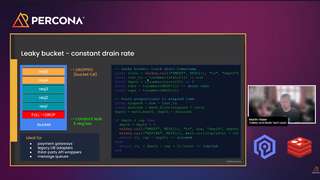
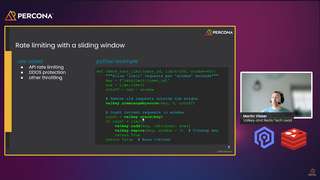
Traffic spikes and “noisy neighbors” can quickly saturate backend resources. In this session, Martin Visser (Valkey and Redis Tech Lead @ Percona) explores robust rate-limiting strategies to protect system resilience and ensure fair resource allocation.
Discover how CVE-2025-14847 (“MongoBleed”) can expose MongoDB to high-severity information disclosure—allowing an unauthenticated remote client to extract fragments of uninitialized server memory when zlib network compression is enabled on a network-reachable instance.
Join Percona as it sponsors the Cloud Native Databases virtual event on February 20–21, 2026, featuring insights from key Percona leaders and engineers. Founder Peter Zaitsev, Software Engineer Ege Gunes, and Software Engineer George Kechagias will take the stage to share their perspectives and real‑world experience, highlighting how Percona’s open source services and tools empower teams to build, run, and scale modern database platforms with confidence in cloud environments.
Sorted Sets are one of the most powerful data structures in Valkey and Redis, but they are often only associated with gaming leaderboards. In this session, Martin Visser (Valkey and Redis Tech Lead @ Percona) dives deep into how sorted data structures can solve complex engineering challenges with high efficiency.
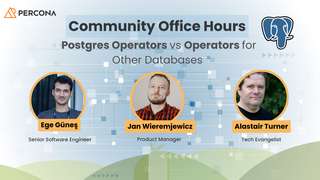
There’s a lot of discussion about comparing Kubernetes operators for Postgres, but what about how Postgres operators compare to operators for other databases?
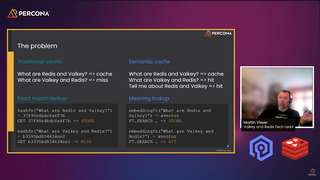
Setting up efficient LLM applications requires more than just calling an API. In this session, Martin Visser explains how semantic caching can significantly reduce the cost and latency of Large Language Model (LLM) applications by reusing meaningfully similar responses instead of exact matches.
We’re excited to share that Peter Zaitsev, Founder of Percona, will present his talk “Why PostgreSQL Took the Crown from MySQL and What Lies Ahead.” After participating in Percona PGConf.EU in Riga, Peter is bringing this session to our community once again, with updated insights and perspectives from recent conversations with PostgreSQL experts and users.
Join the Community Office Hours This session focuses on MySQL built on Percona Server for MySQL with native MySQL Group Replication on Kubernetes. It’s a significant step for the MySQL and Cloud Native community, offering more open-source options for deploying reliable, consistent MySQL clusters at scale.
We’re gathering in San Francisco on January 14 for a focused, in‑person summit dedicated to strengthening the MySQL ecosystem through collaboration and contribution.
We’re gathering in Brussels on February 2nd for a focused, in-person summit dedicated to strengthening the MySQL ecosystem through collaboration, contribution, and community building.